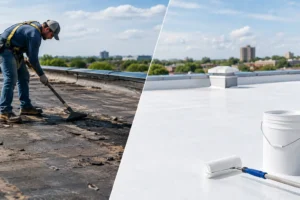
This guide covers the optimal timing windows for full roof replacements in New Jersey asphalt shingle, architectural shingle, and flat/low-slope membrane systems. It addresses weather thresholds, contractor availability, material performance, and permit timing. It does not cover minor repairs, storm damage insurance claims processes, or commercial roofing systems above 50,000 square feet
Who This Is For (And Who Should Stop Reading)
You’re a New Jersey homeowner probably in Bergen, Morris, Monmouth, Burlington, or Ocean County staring at a roof that’s 18+ years old, showing granule loss in the gutters, or recently flagged by a home inspector. You want to know whether to schedule the job this fall, wait until spring, or push through in winter. You’re not a contractor. You don’t need to know how to install shingles. You need to know when to book, when to wait, and why timing actually matters structurally and financially.
Stop reading if you’re dealing with an active leak, missing shingles after a storm, or visible deck rot. That’s emergency repair territory timing optimization doesn’t apply when water is entering your home. Call a contractor immediately.
The Core Protocol
Step 1: Identify Your Target Window — Late Summer to Mid-Fall
The best time to replace a roof in New Jersey is late August through October. This is not a rough guideline it’s based on how asphalt shingles actually cure.
Asphalt shingles require temperatures between 40°F and 85°F during installation for proper sealing. GAF, CertainTeed, and Owens Corning all specify in their installation documentation that self-sealing adhesive strips need sustained warmth typically 10 to 14 days post-installation to activate properly. In New Jersey, late summer and early fall delivers exactly that. Daytime highs run 65°F to 80°F. Nights stay above 50°F.
September is frequently the sweet spot. Rain events are shorter and more predictable than spring. Humidity is lower than July or August. Contractor crews are experienced and working at full capacity before the holiday slowdown.
Step 2: Book Your Contractor in June or July
Most New Jersey roofing contractors especially the reputable ones with full crews and proper insurance are booked 6 to 10 weeks out during peak season. If you call a roofer in September hoping for a September start, you’re getting October at best, and a B-team crew more likely than not.
Call in June. Get three quotes. Sign a contract with your preferred contractor and lock in a late-August or September date. Pay your deposit, confirm permit filing is the contractor’s responsibility (it is, in most NJ municipalities), and set a calendar reminder for two weeks before start date to confirm shingle delivery.
Step 3: Understand the Spring Window — April to Early June
April 15 through June 10 is your second-best window. After a long winter, homeowners are motivated, damage is fresh in mind, and contractors are hungry for work in April before the summer rush.
The risk in spring: New Jersey springs are wet. Bergen and Morris counties average 4.5 to 5 inches of rain in April and May. An open deck sits exposed between tear-off and installation. A good contractor uses synthetic underlayment not felt paper which can handle light rain exposure for 24 to 48 hours. Confirm your contractor is using a product like GAF Deck-Armor or CertainTeed RoofRunner before signing any spring contract.
Also confirm what your contractor’s weather policy is. Legitimate contractors will not install shingles below 40°F. In New Jersey, late April nights can still dip to 35°F shingles installed in those conditions won’t seal properly and can lift, void your manufacturer warranty, and leave you arguing with CertainTeed about a claim two years later.
Step 4: Schedule the Permit Well in Advance
In New Jersey, a roof replacement above a certain scope defined differently by municipality typically requires a building permit. Cherry Hill Township, Toms River, and Edison all require permits for full replacements. Permits in NJ municipalities take anywhere from 5 to 21 business days to process. Your contractor should be pulling this permit, not you. If they’re not, that’s a red flag.
Permit delays in spring are common because municipalities get slammed after winter. Book your contractor who files permits in March and you’ll have a cleaner April start.
Step 5: Confirm Material Lead Times
After supply chain disruptions in 2021 and 2022, shingle availability normalized but specific premium products (architectural, impact-resistant, designer grades) can still require 2 to 4 week lead times from distribution. If you’re going with GAF Timberline HDZ, you’re fine. If you’re speccing Owens Corning Duration Storm or CertainTeed Landmark Pro in a particular color, confirm availability before signing. A contractor who orders materials on the day of demo is not organized enough for your job.
—
Contraindications: When NOT to Use This Protocol
Do not schedule a planned replacement between November 15 and March 15. New Jersey winters make roofing genuinely problematic. Temperatures regularly drop below 40°F in January and February across the entire state. Essex, Passaic, and Sussex counties see sub-freezing weeks. Shingles become brittle and crack during installation. Ice on the deck creates safety hazards that even experienced crews cut corners around.
If a contractor is aggressively pushing a December start date with a steep discount, ask yourself why they have availability in December. It’s either because work dried up concerning for a busy contractor or they’re willing to install in conditions that manufacturers explicitly warn against.
Do not install flat or TPO membrane systems in temperatures below 40°F. The adhesives and heat-welded seams used in modified bitumen and TPO systems need warmth to bond. A botched winter seam on a flat roof over a garage or addition will leak by March.
—
How This Is Typically Done Wrong
Mistake 1: Scheduling based on when you got the insurance check. Storm damage claims often resolve in winter months November through February. Homeowners receive their settlement and immediately want the work done. Understandable. But installing in January on a 28°F day because the insurance money landed is a poor tradeoff. Store the check, book a spring or fall slot, and use temporary tarping if needed. Shingles installed below manufacturer temperature specs void your warranty.
Mistake 2: Booking the first available contractor instead of the right available contractor. High-quality roofers in New Jersey — the ones carrying General Liability of $1M+ and $500K workers’ comp, pulling proper permits, using manufacturer-certified crews — are booked solid in September and October. The contractor who can start next Tuesday in mid-October is available for a reason. Availability in peak season is a signal, not a convenience.
Mistake 3: Ignoring the underlayment specification. Many homeowners focus entirely on the shingle brand and color. The underlayment is what protects your home during the installation window sometimes 1 to 3 days between tear-off and full installation. Old 15-lb felt paper, still widely used by lower-cost contractors, saturates quickly in rain and can cause deck swelling. Synthetic underlayment costs roughly $0.10 to $0.15 more per square foot. On a 2,000 square foot roof, that’s $200 to $300 extra. Worth every dollar in a New Jersey spring.
—
Edge Cases That Require Deviation
Emergency replacement in November or December. If your deck is compromised — structural rot, major storm damage, interior water intrusion you cannot wait for spring. In this case, work with your contractor to install a complete synthetic underlayment system immediately, then schedule full shingle installation in April. Some contractors will do a winter shingle install with hand-sealing of every tab using roofing cement as a workaround for the cold, but this is labor-intensive, adds cost, and is only worth it if the structural integrity of the home is at immediate risk.
Historic homes with older housing stock. Properties built before 1970, particularly in areas like Cape May, Lambertville, or Montclair, often have board sheathing rather than plywood decking. Board sheathing expands and contracts differently and can be more vulnerable to moisture exposure during open periods. For these homes, schedule in late summer specifically August when rain events are shorter and drying time is faster. A longer open-deck window is riskier with board sheathing. Worth noting: some of these older homes also have steeper pitches and more complex geometry, which adds crew time and makes weather delays more consequential.
Solar panel installations planned within 12 months. If you’re planning to add solar within the next 12 to 24 months, your roofing timeline changes significantly. Solar installers will not mount panels on a roof older than roughly 10 years, and any roof replacement after solar installation requires panel removal and reinstallation costing $1,500 to $4,000 in additional labor. Replace your roof first, ideally in fall, then contract solar for spring installation on your fresh roof.
HOA-restricted communities in South Jersey. Some HOAs in planned communities in Burlington and Camden counties have submission and approval processes for exterior changes including roofing. Approval cycles can run 30 to 60 days. If you’re in an HOA, submit your shingle color and manufacturer documentation in July for a fall replacement. Miss that window and you’re waiting until spring.
When to Escalate to a Professional
Beyond “call a roofer when you need a roof,” here’s exactly when you need expert eyes before making any timing decision:
If you see sagging between rafters, visible from the attic or from the street, your deck may be compromised. This changes the project scope from a shingle replacement to partial or full deck replacement different cost, different timeline, different permit category in some municipalities.
If your home was built before 1978 and has multiple existing shingle layers, asbestos-containing materials may be present in the underlayment or older shingles. A New Jersey-licensed asbestos abatement contractor must assess before any tear-off. Do not let a roofing crew start demo on a pre-1978 multi-layer roof without this assessment completed.
If your attic shows active mold growth, black staining on sheathing, or condensation on the underside of the deck, you have a ventilation problem that a new roof alone won’t fix. Installing new shingles over an improperly ventilated deck will void your manufacturer warranty GAF, CertainTeed, and Owens Corning all specify minimum ventilation ratios in their warranty terms (typically 1:150 or 1:300 net free area depending on moisture control strategy). Escalate to a contractor who can address both ridge and soffit ventilation as part of the replacement scope.
Key References and Standards
NRCA Roofing Manual (National Roofing Contractors Association): The industry baseline for installation standards in the U.S., including temperature thresholds and material handling requirements. Your contractor should be familiar with this document.
IRC Section R905 (International Residential Code): Covers roofing material installation requirements. New Jersey has adopted the IRC with state amendments NJ-specific updates are maintained by the New Jersey Department of Community Affairs, Division of Codes and Standards.
Manufacturer Installation Instructions: GAF, CertainTeed, and Owens Corning publish specific installation temperature limits and warranty conditions for each product line. These are not suggestions — violating them voids warranty coverage. Request a copy of the spec sheet for any product being installed on your home.
ASHRAE 160: Standard for moisture control in buildings — relevant if your escalation path includes addressing ventilation or moisture issues before replacement.
New Jersey Uniform Construction Code (UCC): Governs permit requirements for roofing in NJ. Your local municipal building department administers this. Permits are required for full replacements in most NJ jurisdictions; re-roofing over existing shingles has variable requirements by municipality.
The bottom line is that New Jersey’s climate gives you two reliable roofing windows per year. Miss both and you’re either rushing in dangerous cold or reacting to an emergency. Plan in June, sign a contract in July, and be on a crew’s calendar for September. That single decision — made months early — is what separates a smooth replacement from a winter scramble on a compromised deck.